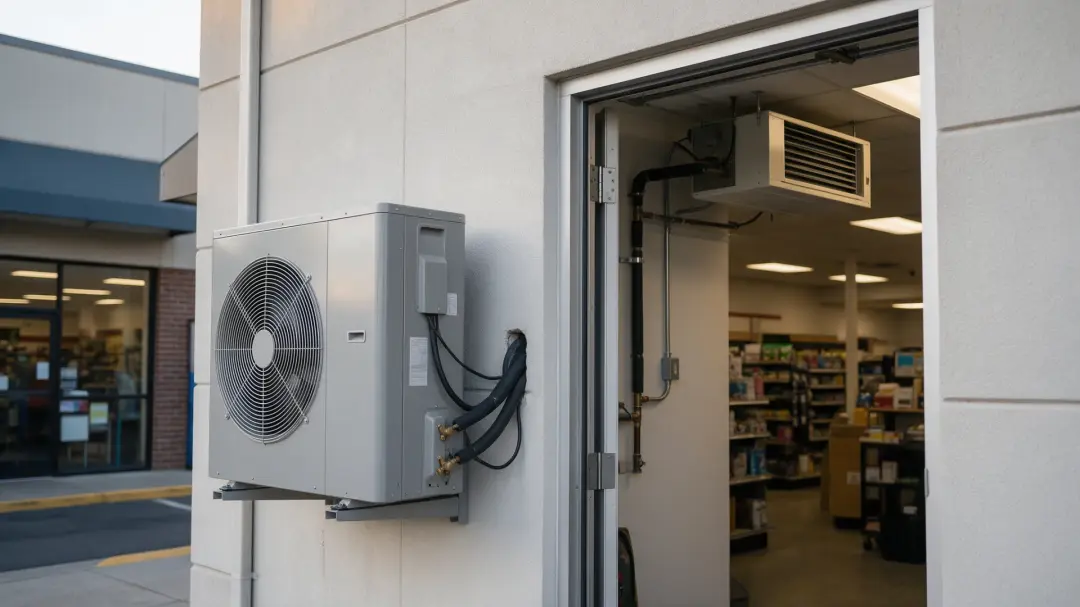
Installing a heat pump in an occupied business requires a plan for customers as well as contractors. Some interruption may be unavoidable, but preparation can reduce its duration and prevent surprises. The aim is to identify disruptive tasks early and keep public access safe throughout the project.
Protect the customer journey first
Walk the route from the pavement or car park to the entrance, tills, toilets and exits. Delivery vehicles, lifting operations and temporary barriers must not turn that route into a work area. Maintain accessible alternatives wherever the normal route changes.
HSE’s provisional 2025/26 figures record 104 members of the public killed in work-related accidents across industries. This is not a heat pump installation statistic; it underlines the importance of separating the public from work. Follow task-specific risk controls rather than relying on warning signs alone. See the latest HSE figures and public-protection guidance.
Separate preparation from the changeover
Surveying, ordering equipment and agreeing routes should happen before the planned heating shutdown. Where the design allows, supports, cable routes and parts of the new pipework can be prepared while existing heating remains available.
Confirm that equipment and critical fittings are on site before removing the old system. Discovering a missing component after disconnection can extend an interruption that otherwise might have been short. Ask which dependencies could delay the changeover.
Schedule the tasks that customers will notice
Drilling, heavy deliveries and opening ceiling spaces can affect customers even if heating remains operational. Match those tasks to quieter periods and the business’s actual timetable. Early mornings are not automatically suitable for a hotel, café or premises with neighbouring residents.
Define the work window and contingency window separately. Staff need to know when an area becomes unavailable, when it should reopen and who decides whether it is ready. Avoid promising uninterrupted trading before the survey has established what the work requires.
Plan temporary comfort and essential facilities
If occupied spaces lose heating, assess temporary arrangements against electrical capacity, fire precautions and safe circulation. Hot water interruption may affect cleaning, food preparation or guest services differently from a brief loss of space heating.
For some projects a limited closure or phased area shutdown is the practical choice. Cost that option alongside temporary provision. A shorter, clearly communicated closure can be easier to manage than unpredictable restrictions spreading across several trading days.
Keep stock, staff and customers informed
Agree dust protection, storage of removed equipment and daily clean-down responsibilities. Sensitive stock or food-service areas may need additional isolation. Contractors should know which equipment and spaces are operationally critical.
Give staff concise notices they can explain confidently: the affected area, expected duration and available alternative. Customers need useful directions, while the business needs a named contact for changes to the installation timetable.
Reopen after checks, not just after installation
Check barriers, trip hazards, access routes and cleanliness before returning an area to public use. Heating commissioning and electrical certification should be completed as required; physical installation alone does not establish readiness.
For premises in Horsham, discuss the trading plan with Air Source Heat Pumps West Sussex at the survey stage. Include staff training, fault reporting and the arrangements for any return visit so the handover does not leave another unplanned interruption.
Agree a daily site coordination routine
A short daily review helps staff understand which spaces are available and which tasks may be noisy. Confirm access routes before opening and check that contractors have somewhere appropriate for tools and materials. Avoid allowing temporary storage to spread into customer or emergency routes.
The review should have a named decision-maker on each side. If a delivery is delayed or hidden pipework changes the work required, someone must decide how the programme adjusts and communicate the consequence. Staff should not have to infer reopening times from whether equipment appears nearly finished. Keep a written record of material changes to the agreed sequence.
Prepare for a longer interruption
Identify the operational tasks that depend on heating or hot water and decide which can move elsewhere temporarily. Check whether bookings, catering or cleaning need to be rescheduled if the changeover extends beyond its planned window.
A contingency is useful only when the responsible staff understand it. Agree who authorises temporary arrangements and who updates customer information. Discuss the conditions that would make closing an affected area necessary, so a last-minute decision does not depend on conflicting assumptions.
Summary
Reduce disruption by planning public access, preparatory work, shutdowns and reopening as one coordinated project. Make the contingency arrangements explicit before the existing heating is disconnected. Our retail installation service can help establish a workable sequence.